
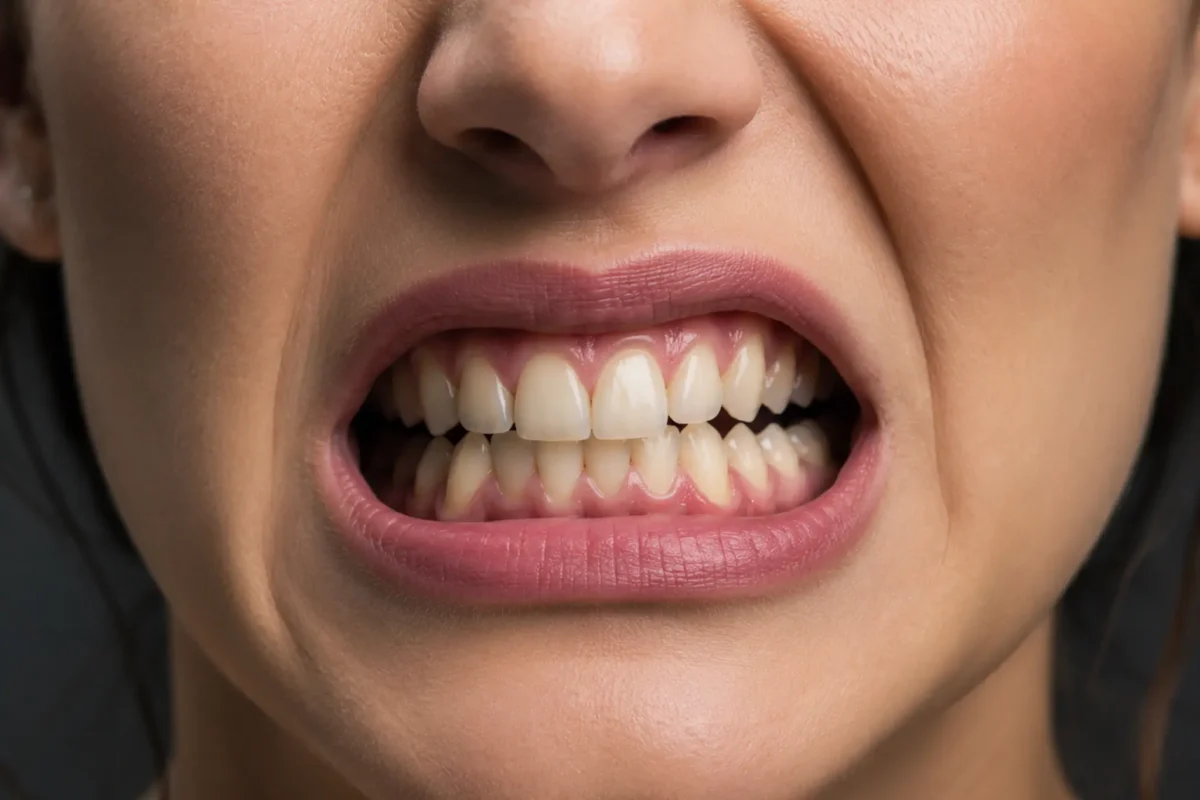
“| Already Tried Botox… Why Am | Still Grinding My Teeth?”
Every night, Sarah would wake up exhausted—not because she didn’t sleep enough, but because her body never truly rested. She woke up with jaw pain, headaches, tightness in her face, neck tension, and sometimes even ear symptoms. Her dentist told her, “You grind your teeth.”
So she did what most people do: she got a night guard, then Botox. For a while, things felt better, but a few months later, the clenching came back because the jaw was never the real problem—it was the messenger.
Bruxism Is Not Just About the Teeth
Most people think bruxism is simply “a teeth grinding problem,” but modern research tells us something very different. Bruxism is often a sign that the body is under stress, and stress does not only mean emotions.
The body can experience emotional stress, neurological stress, breathing stress, sleep stress, and mechanical stress. Sometimes, the jaw becomes the place where all this tension gets expressed.
Sleep Bruxism: When the Body Is Fighting During Sleep
Studies show that sleep bruxism commonly happens during transitions between sleep stages. Right before clenching episodes, researchers often find increased brain activity, increased heart rate, and activation of the nervous system. It’s almost as if the body briefly shifts into an alert state.
Sometimes the body is trying to breathe. During sleep, the airway may slightly narrow, oxygen drops, the brain senses stress, and immediately the nervous system reacts. The jaw muscles tighten, the body shifts, and the mouth clenches.
In some people, bruxism may actually be the body’s way of trying to protect the airway. That’s why chronic grinders often also have mouth breathing, snoring, poor sleep quality, tongue dysfunction, sleep apnea, and chronic fatigue.
The Nervous System Never Lies
The jaw has a very close relationship with the autonomic nervous system, especially the sympathetic nervous system—the system responsible for fight or flight. The sympathetic nerves affecting the jaw are closely linked to the upper thoracic region around T1–T5.
At the same time, the parasympathetic system—the system of rest and recovery—must balance this response. This is where the vagus nerve becomes important, because if the body cannot properly shift into a relaxed state, the muscles never fully let go.
Awake Bruxism: The Silent Clenching We Don’t Notice
Awake bruxism often happens during concentration, emotional stress, overthinking, working, driving, or studying, and many people don’t even realize they are doing it. Their teeth stay touching all day long, and their jaw never truly rests.
Your Jaw Has a Resting Position
A healthy resting jaw position is: lips gently closed, teeth slightly apart, tongue resting on the roof of the mouth, and relaxed nasal breathing. That small space between the teeth matters more than people think.
Sometimes the Problem Starts Far Away From the Jaw
The body works as one connected system. The jaw is connected to the tongue, the neck, the diaphragm, the hyoid bone, posture, and fascial chains. Even pelvic tension can sometimes influence the jaw through the deep front fascial line.
When this system loses balance, certain muscles become overactive, including the masseter, temporalis, and lateral pterygoid.
The Tongue Is Part of the Story Too
Poor tongue posture may contribute to airway narrowing, mouth breathing, unstable jaw positioning, and increased nervous system activation. The tongue is not just a muscle inside the mouth—it is part of the breathing system.
Botox Is Not Wrong… It’s Just Incomplete
Botox can absolutely help decrease muscle force, reduce pain, and protect the teeth. However, if the root cause remains—poor sleep quality, airway dysfunction, nervous system overload, stress physiology, tongue dysfunction, or breathing dysfunction—the body often finds its way back to clenching again.
Because symptoms are messages, and silencing the message is different from understanding why it appeared.
Bruxism Is the Body Saying:
“Something is stressing me.”
Maybe emotionally, maybe physically, maybe neurologically, or maybe mechanically.
The question is not only, “How do we stop the grinding?” The deeper question is, “Why does the body feel the need to grind in the first place?”
